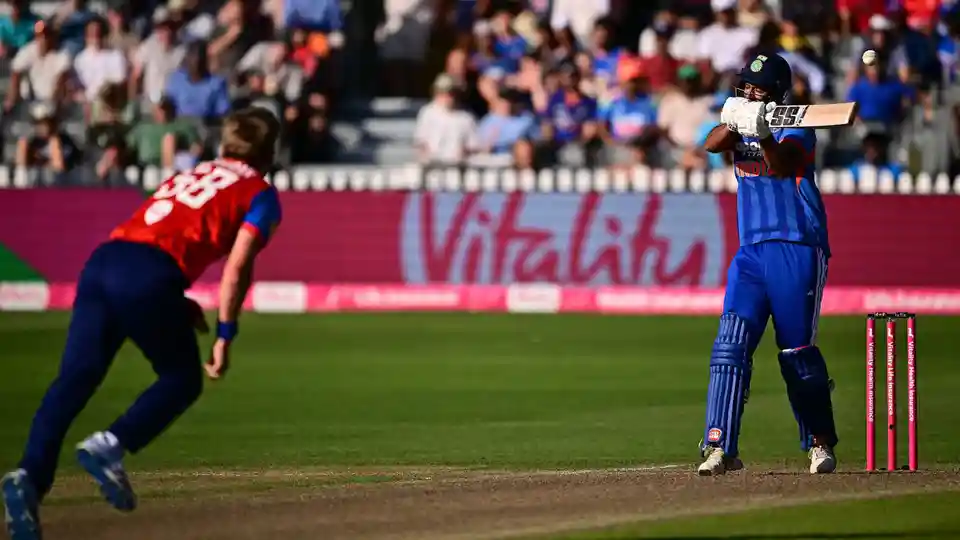
England crushed India with a bowling masterclass in Bristol, restricting them to just 159—well below the venue’s 206 average. Hard lengths, smart fields, and relentless variation left India’s batters clueless.
How England’s attack exposed India’s weaknesses
Three balls. One pull shot. Out. Vaibhav Sooryavanshi and Ishan Kishan fell in the Powerplay, trapped by Jofra Archer and Josh Tongue’s hard lengths. Abhishek Sharma followed in the seventh over, undone by Adil Rashid. England’s plan was simple: attack the bounce, deny rhythm, and station fielders at square leg and deep backward square. It worked to perfection.
Harry Brook’s captaincy kept India guessing. Never more than three pace or spin overs in a row. Will Jacks, introduced early, stifled the middle order with pace variation—77 to 99 kph—conceding just 28 in four overs. India’s spinners, meanwhile, offered no such subtlety, consistently topping 90 kph and getting quicker when hit.
India’s straight boundary drought
England’s control was absolute. Against Archer, Tongue, and Sam Curran, India failed to clear or pierce the shorter straight boundary once. Fifteen hits down the ground yielded just nine runs. England, by contrast, smashed four boundaries—including two sixes—in the same region.
- India’s final score: 159 (below Bristol’s 206 average)
- England’s seamers in last 3 overs: 17 runs, 1 boundary
- Will Jacks’ spell: 4 overs, 28 runs, 1 boundary
- India’s runs off fuller deliveries (4m+): 13 from 11 balls, 1 boundary
Death bowling seals the deal
With the older ball gripping, England’s seamers turned the screws. Archer and Tongue took pace off, Curran mixed in yorkers. Ten slower deliveries. Four singles. Two wickets—Tilak Varma and Washington Sundar. The chase was a formality. The game was already won in 20 overs of ruthless execution.
Next up? The series shifts to [next venue], where India must find answers—or face more of the same.