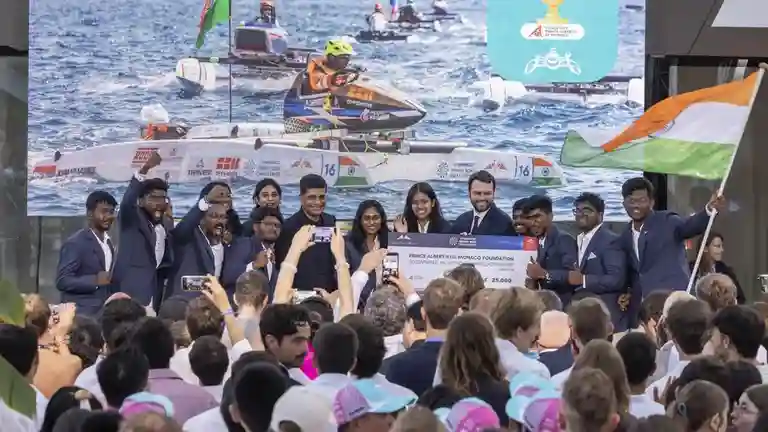
Team Sea Sakthi from Coimbatore’s Kumaraguru College of Technology (KCT) secured the Foundation Prince Albert II Award at the Monaco Energy Boat Challenge 2026, earning a €25,000 development grant for its battery thermal management innovation. The win marks India’s first victory in the Energy Class category, validating a low-cost, scalable solution with applications beyond marine propulsion.
Why This Battery Breakthrough Matters for Investors
The team’s three-module lithium-ion battery pack integrates an active cooling system with Phase Change Material (PCM) made from Paraffin Wax and Expanded Graphite—a combination chosen for its cost efficiency and accessibility. Unlike existing thermal management systems that may shut down under stress, this design stabilizes temperature to sustain performance, a critical advantage for electric vehicles (EVs) and autonomous systems where thermal safety is non-negotiable.
Competitive Edge in a Global Clean Tech Race
Out of 46 international teams at the Yacht Club de Monaco, Team Sea Sakthi was one of 26 in the Energy Class and the sole winner of the FPAII Award. The 12-member multidisciplinary team, spanning engineering disciplines from propulsion to electronics, has competed consistently in the challenge for five years—this is its first shortlist and win. Captain Raghav A noted the achievement underscores Indian engineering’s ability to lead in sustainable marine technology.
Commercial Potential and Next Steps
The €25,000 grant will fund further validation of the technology, which the team plans to commercialize for electric marine mobility, EVs, and other battery-dependent sectors. Key specifications of the innovation include:
- Active cooling system with custom cell brackets
- PCM using Paraffin Wax and Expanded Graphite
- Cost-effective, scalable materials
With global demand for safer, high-performance battery solutions rising, this win positions Team Sea Sakthi—and by extension, India’s clean tech ecosystem—as a player to watch in the transition to zero-emission mobility.


