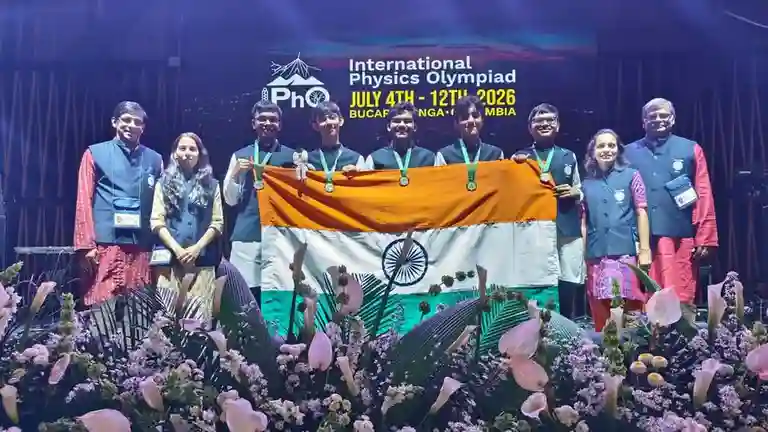
India has clinched the top spot at the 56th International Physics Olympiad (IPhO) 2026, with all five of its students securing gold medals. The country shared the first position with China, Kazakhstan, Russia, South Korea, and Taiwan in the team rankings.
India’s Dominance in Global Physics Competitions
This marks the second time India has achieved a clean sweep of gold medals at the IPhO, the first being in 2018. Over its 27-year participation history, nearly 44% of Indian students have won gold, 41% silver, 10% bronze, and 5% honorable mentions, according to the Homi Bhabha Centre for Science Education (HBCSE), the anchor institution for the Indian team.
In the past decade, Indian participants have consistently secured either gold (62%) or silver (38%) medals, underscoring the nation’s growing strength in STEM education.
IPhO 2026: Key Highlights and Performance Metrics
The competition, held in Colombia from July 5 to July 12, saw 381 students from 85 countries vie for medals. A total of 51 gold, 80 silver, and 97 bronze medals were awarded. The overall winner was a South Korean student, while Iran’s participant excelled in the experimental component.
- All five Indian students—Kanishk Jain (Pune), Riddhesh Anant Bendale (Indore), Rishit Garg (New Delhi), Shresth Suraiya (Mumbai), and Svarit Joshi (Ahmedabad)—won gold.
- The theoretical exam featured problems on thermodynamics, photoionization, and electron-positron dynamics, with Indian students scoring near-perfect marks.
- The experimental component focused on thermodynamic processes in fluids and heat transfer, where Indian participants also performed exceptionally.
Training and Mentorship Behind the Success
The Indian team underwent rigorous preparation, including orientation and pre-departure camps at HBCSE. The contingent was accompanied by Prof. Anwesh Mazumdar (HBCSE-TIFR), Dr. Leena Joshi (St. Xavier’s College), and scientific observers Prof. Ananda Dasgupta (IISER Kolkata) and Nisha Kelkar (Gogate-Joglekar College).
This achievement highlights India’s rising prominence in global STEM competitions, signaling potential long-term benefits for its education sector and tech-driven economy.


