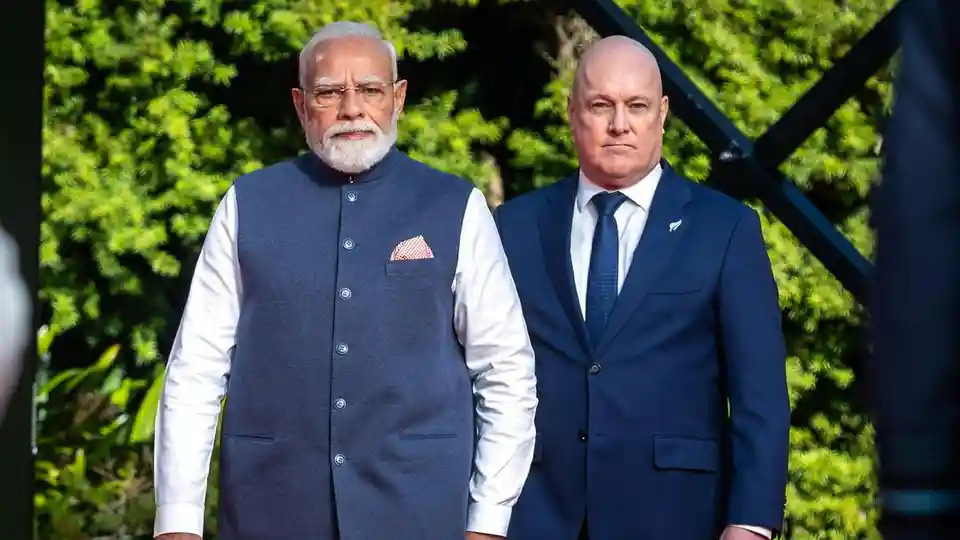
India and New Zealand on Saturday upgraded their bilateral relationship to a strategic partnership, setting a target to double annual trade to ₹35,000 crore by 2030 following talks between Prime Minister Narendra Modi and New Zealand counterpart Christopher Luxon in Auckland.
The meeting produced 18 outcomes, including 10 formal agreements. Among the key deliverables were a four-year roadmap for expanded cooperation, a framework for Indo-Pacific maritime collaboration, and a reciprocal logistics support arrangement between the Indian Navy and New Zealand Defence Force.
Indo-Pacific focus and trade expansion
A joint statement noted both leaders reaffirmed their commitment to a free, open, and prosperous Indo-Pacific, emphasizing sovereignty, territorial integrity, and a rules-based international order. They also called for freedom of navigation and overflight in accordance with the 1982 UN Convention on the Law of the Sea.
The two nations agreed to establish a maritime security dialogue to strengthen coordination and information sharing. This follows the recent signing of the India–New Zealand Free Trade Agreement (FTA), with both sides pledging to work toward its early implementation.
Global concerns and UN reform
Modi and Luxon expressed concern over escalating tensions in West Asia, urging restraint and civilian protection. They also called for unrestricted navigation through the Strait of Hormuz and opposed any constraints on shipping.
Both leaders advocated for "bold and effective" UN reforms, including expansion of the Security Council, and reiterated their support for dialogue and diplomacy to resolve conflicts in line with international law.