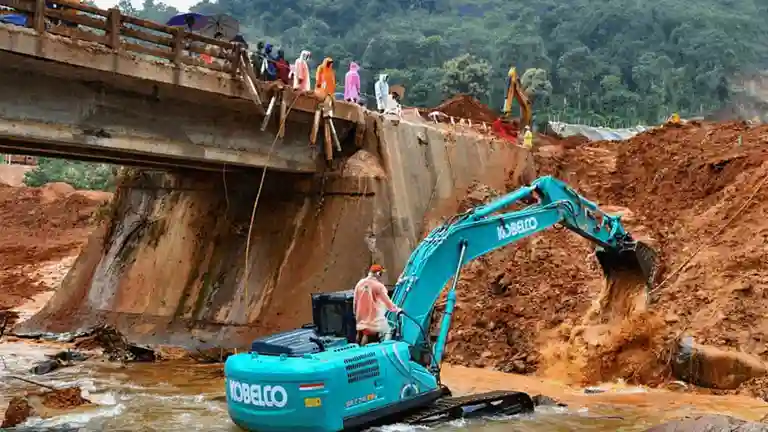
A Dilip Buildcon Limited (DBL) internal report warned of an imminent slope collapse at the Anakkompoyil Meppadi tunnel’s North Portal in Wayanad before the July 7 landslide that killed seven people.
The landslide struck near Meenakshi Bridge at Kalladi, where construction on the tunnel—meant to connect Wayanad and Kozhikode—had been underway since last year. Kerala Minister T. Siddique later called the disaster “man-made,” citing negligence at the site.
Unstable Slope Conditions Identified
Engineers inspecting the North Portal between June 3 and June 11 found a 35-meter-thick layer of loose, silty soil resting over solid rock on the left slope. The soil’s poor drainage caused water accumulation during heavy rainfall, increasing landslide risk.
Despite stabilization efforts—stepped carving, shotcrete reinforcement, and soil nails—the slope continued deteriorating. Inspectors documented widening cracks, earth slippage, muddy water leaks, and underground cavities. A critical finding was the sound of water flowing beneath the surface, signaling hidden erosion.
Report Highlighted High-Risk Zone and Inadequate Safeguards
The left-side slope was deemed the highest risk, with the report warning it “may culminate in sudden slope failure at any time” under heavy rain. Drainage holes were non-functional, and key monitoring instruments, like piezometers, had not been installed.
Trial blasting occurred on June 5, 6, and 11 despite the slope’s instability, though the report attributed deterioration primarily to rainfall, not vibrations. A nearby concrete-mixing plant was also flagged as a potential risk due to its weight and vehicle movement.
Recommended Measures and Contractor Response
The report urged immediate actions, including gabion walls, protective matting, tarpaulin sheets, and lined drainage channels to divert rainwater. It also called for assessments of soil nails and drainage holes under waterlogged conditions.
Dilip Buildcon denied technical errors, citing 265 mm of rainfall in 24 hours and strict compliance with engineering, safety, and environmental protocols. The project, it noted, is under regulatory oversight, including by a Supreme Court-appointed committee.