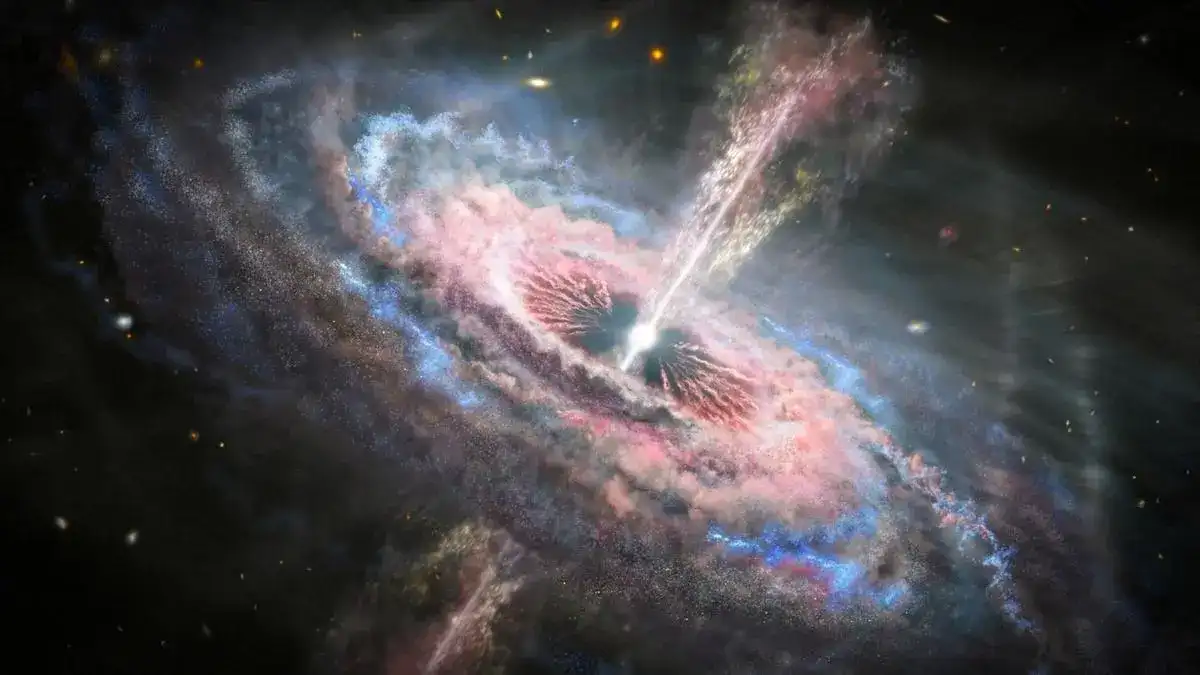
New observations from the European Space Agency’s Euclid space telescope have uncovered 31 ancient quasars, including the two earliest known, dating back over 13.1 billion years—when the universe was just 5% of its current age. These findings intensify a long-standing puzzle: how supermassive black holes grew so rapidly in the primordial cosmos.
Why Early Quasars Defy Astrophysical Expectations
Quasars are the ultra-luminous cores of galaxies, powered by supermassive black holes consuming matter at extraordinary rates. The two earliest specimens shine a trillion times brighter than the sun, yet their existence so soon after the Big Bang contradicts current models of black hole formation. Researchers suggest either these black holes were born massive or grew at unprecedented speeds—neither of which aligns with prevailing theories.
During the epoch of reionization (or cosmic dawn), the universe transitioned from a dense, neutral hydrogen fog to a transparent state. The discovery of mature quasars in this era implies that galaxies and their central black holes developed far earlier than anticipated, challenging timelines for cosmic evolution.
Market and Scientific Implications of the Discovery
The Euclid space telescope, launched in 2023 primarily to study dark energy and dark matter, has delivered a scientific windfall. Prior to Euclid, only a handful of early quasars had been identified due to observational limitations. Now, astronomers can analyze these objects as a population, offering new insights into black hole seeding and growth mechanisms.
- 31 newly identified quasars, including the two oldest known (13.1B years old)
- Black holes in these quasars may weigh hundreds of millions to billions of solar masses
- Early universe was 8x smaller in linear scale, accelerating cosmic interactions
For investors and tech stakeholders, this breakthrough underscores the value of next-gen space telescopes like Euclid and the James Webb Space Telescope (JWST). These instruments are not only advancing fundamental science but also driving demand in aerospace, data analytics, and computational astrophysics—sectors poised for growth as cosmic discoveries accelerate.
As study co-author Joseph Hennawi notes, the pressure is now on to explain how supermassive black holes achieved such scale in a universe barely 670 million years old. The answer could redefine our understanding of galaxy formation, dark matter’s role, and even the economics of cosmic resource allocation in the early universe.


