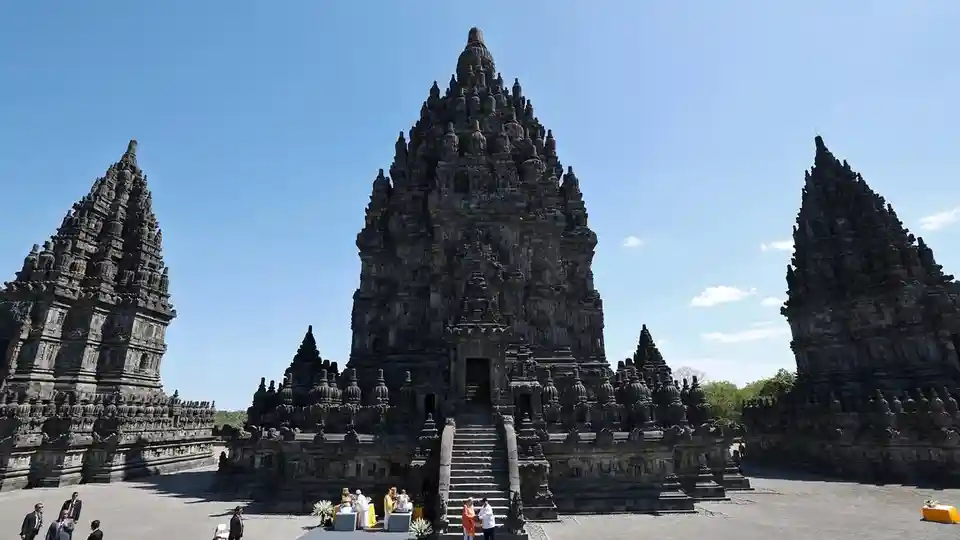
Prime Minister Narendra Modi and Indonesian President Prabowo Subianto offered prayers at Prambanan Temple, a 9th-century UNESCO site near Yogyakarta and Indonesia’s largest Hindu complex, housing the trimurti of Brahma, Vishnu, and Shiva. The visit highlights Indonesia’s unique legal recognition of Hinduism as a monotheistic religion, a status secured in 1962 after decades of adaptation to meet state requirements.
Hinduism’s Legal Adaptation in Indonesia
Indonesia’s legal system mandates monotheism for official religious recognition, a standard Hinduism initially failed to meet in 1952 due to its polytheistic traditions. Reformers under the Parisada Hindu Dharma (later PHDI) reframed Balinese Hinduism around a single supreme deity, Sang Hyang Widhi Wasa, to satisfy the state’s criteria. This concept, rooted in ancient Austronesian and Sanskrit traditions, evolved into Indonesia’s definitive monotheistic godhead by the 1950s.
The state formally recognized six religions—Islam, Protestantism, Catholicism, Hinduism, Buddhism, and Confucianism—as agama in 1965. Hinduism’s inclusion required aligning with Pancasila, Indonesia’s founding principle, whose first tenet is monotheism. PHDI now standardizes Hindu theology and ritual practice nationwide, ensuring compliance with legal monotheism while preserving diverse local traditions.
Religion and State in Indonesia
Indonesia’s national identity is deeply tied to religion, with mandatory declarations on identity cards affecting civic life, from marriage to burial rights. The country does not recognize agnosticism or atheism, and blasphemy remains illegal. While religious freedom is guaranteed, the state’s monotheistic mandate has shaped Hinduism, Christianity, and Islam in Indonesia, often blending global doctrines with local practices.
The process of standardizing Hinduism in Indonesia mirrors broader patterns of religious evolution, where state policies and faith traditions mutually influence each other. Indigenous groups have also adopted Hinduism as a legal framework, retaining ancestral worship, animal sacrifice, and nature rituals under its umbrella. The debate over religious purity and adaptation remains ongoing.